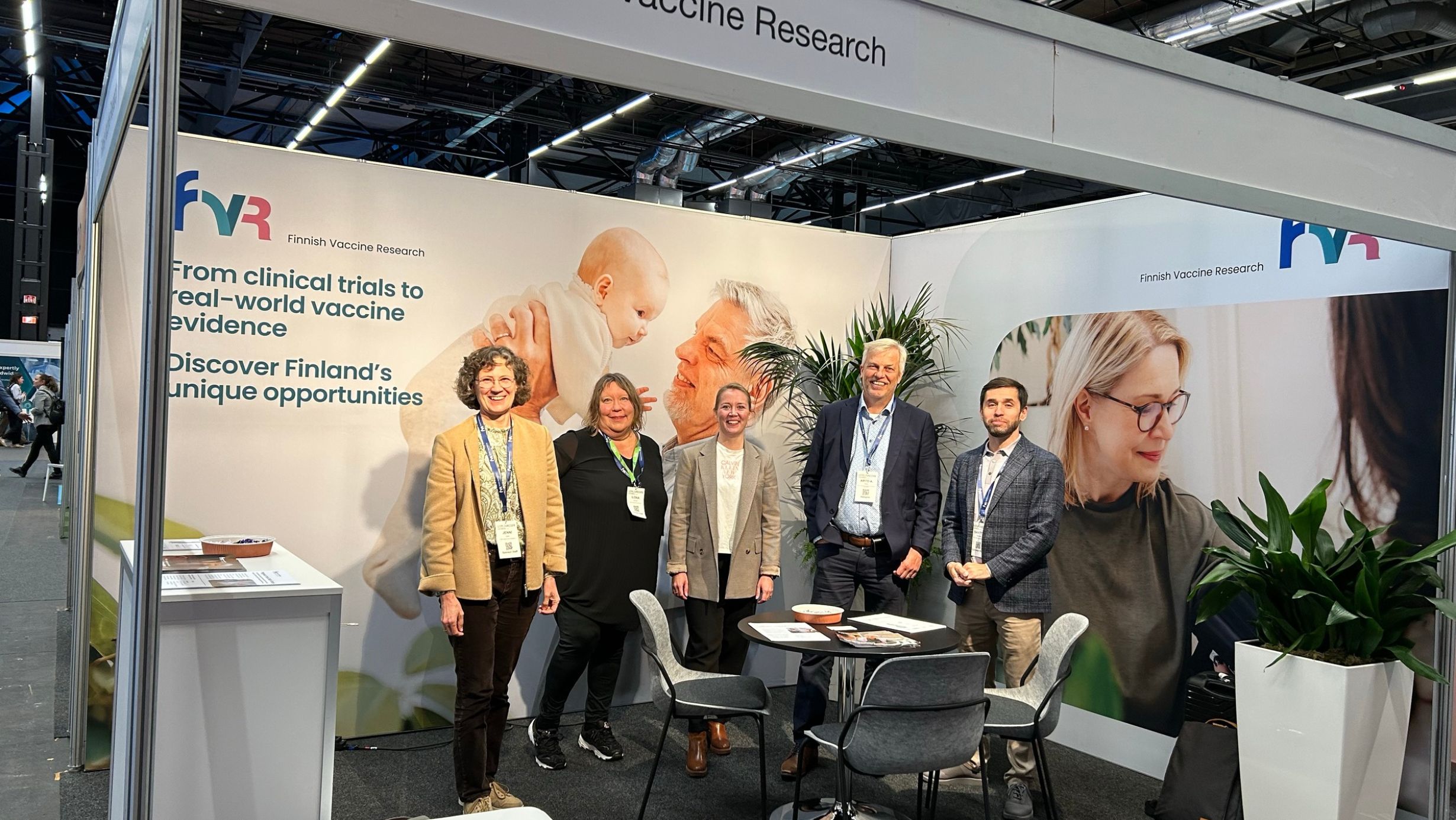
How can vaccine developers accelerate clinical trials while maintaining high standards of safety and quality? At World Vaccine Congress Europe 2026 in Amsterdam, discussions explored opportunities to optimise trial design, streamline study operations and generate evidence beyond conventional clinical settings. FVR's Senior R&D Specialist Marissa Gripenberg shares her three observations from the congress.
Artificial intelligence featured prominently in discussions on vaccine development, including its potential to support the design of new antigens, adjuvants and vaccine platforms. For clinical research, one particularly interesting discussion focused on the innovative use of modelling as a tool to inform clinical trial design.
"Modelling could help explore different trial scenarios and optimise the design of larger clinical trials, including sample sizes, study groups and dosing," says Marissa. “While it cannot replace clinical data, it could help researchers make more informed decisions about trial design and potentially shorten development timelines.” The discussion reflects a broader challenge highlighted at the congress: the pressure to accelerate vaccine development, whether for pandemic preparedness or commercial programmes, while maintaining rigorous regulatory standards for safety, efficacy and quality.
Digitalisation, closely linked to the discussions on AI, was another recurring theme, particularly its potential to streamline clinical trial processes and make participation easier for study participants.
“Discussions addressed the increased use of registry data, decentralised trial approaches and digital tools for participant recruitment and engagement throughout the study,” Marissa explains.
Digital solutions can support several aspects of trial execution, from recruitment and participant communication to study visit management and operational oversight. By reducing administrative burden and making participation more convenient, they may also help improve participant engagement and retention.
At FVR, digital solutions already support several stages of clinical trial operations. The Osana™ participant portal facilitates study registration, appointment management and participant communication, while connected reporting tools provide visibility into recruitment progress, study visits and operational performance. Digital solutions also support quality oversight through e.g. electronic delegation of study responsibilities and continuous temperature monitoring.
The continued interest in pragmatic trials and real-world evidence was also evident at the congress. Discussions highlighted the need for post-authorisation evidence and pragmatic trial designs that can assess vaccine outcomes in real-world settings.
One topic attracting particular attention was the potential association between herpes zoster vaccination and a reduced risk of dementia. FVR's Chief Scientific Officer, Arto Palmu, presented FinDementia, an ongoing randomised, placebo-controlled pragmatic Phase IV trial investigating whether the recombinant zoster vaccine Shingrix can reduce the risk of dementia in adults aged 76 and older. The trial uses national health registers for long-term follow-up.
Marissa says discussions with other congress participants highlighted international interest in Finland's experience in conducting pragmatic vaccine trials. "Several delegates were interested in Finland's experience with pragmatic studies. Many countries would like to conduct similar trials but have not yet developed the same capabilities," she notes.
Beyond conventional, controlled late-stage clinical studies, Marissa envisions a future in which pragmatic trial designs could enable the randomisation and vaccination of hundreds of thousands of participants, with long-term outcomes followed through national health registers. By combining randomised vaccination with long-term register-based follow-up, pragmatic trials could help generate robust evidence on vaccine outcomes in populations far larger than those typically included in conventional clinical studies. Such approaches could also complement traditional trials by providing insights into long-term outcomes and the effectiveness of vaccines in broader populations.
With its established clinical trial infrastructure and expertise in registry-based research, FVR is well positioned to support both efficient clinical trial execution and evidence generation beyond traditional trial settings.
The discussions at World Vaccine Congress Europe highlighted the evolving landscape of vaccine clinical research, where modelling, digital solutions and pragmatic trial designs are creating new opportunities to improve the efficiency and scope of evidence generation.
For FVR, these developments reinforce the importance of combining established clinical research expertise with innovative approaches to trial design, execution and long-term follow-up. Finland's clinical trial infrastructure and national health registers offer a strong foundation for supporting vaccine developers in generating robust evidence throughout the vaccine lifecycle.




FVR - Finnish Vaccine Research Ltd.
Peltokatu 26, 33100 Tampere
Business ID 3256659-4
info@fvr.fi
Invoicing instructions
Data protection I About cookies I Self-monitoring plan
Osana-tuki: help@fvr.fi

Copyright 2026 FVR - Finnish Vaccine Research


