
For vaccine developers, choosing a research partner is ultimately a risk decision. Can the partner give realistic input on feasibility, recruit the right participants, keep timelines on track, protect data quality and deliver evidence that is useful when the next decision point arrives?
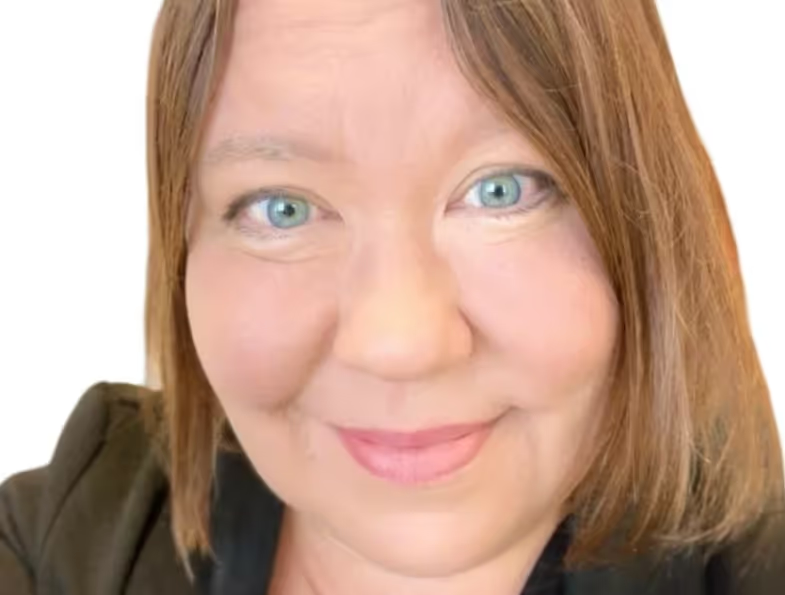
Jenni Vuola understands these questions from both sides of the table. Before joining FVR – Finnish Vaccine Research as CEO in April 2026, she spent twenty years in international pharmaceutical companies, working across clinical research, market access, commercial operations and country-level business leadership. Earlier in her career, she worked in academic vaccine development research, giving her a perspective that combines science, sponsor expectations and operational delivery.
That background now shapes how she leads FVR. “I know what it looks like from the pharma side when a company is assessing a research partner,” says Jenni. “Quality and speed matter most. Price matters too, but it comes after those.”
Her research background includes academic vaccine development work at the Finnish Institute for Health and Welfare and a postdoctoral period at the University of Oxford. She later held roles at GSK, Sanofi Pasteur MSD and Sanofi in Finland and the United Kingdom, including five years as General Manager and Country Lead for Sanofi Finland. She holds a PhD in microbiology and is an Adjunct Professor in infectious diseases research.
A strong research partner reduces uncertainty at the points where vaccine studies most often become vulnerable: feasibility, recruitment, protocol adherence, participant retention, follow-up and data quality. For sponsors, these are not operational details only. They affect whether a study can support clinical, regulatory, medical and market access decisions with confidence.
FVR combines vaccine-specific scientific expertise and registry-based study expertise, operating eight specialized research clinics across Finland with experienced study teams and decades of clinical vaccine study experience. Because vaccines are FVR’s key focus, its teams understand the scientific, operational and participant-engagement challenges that vaccine studies bring, from volunteer recruitment to long-term follow-up and post-licensure evidence needs.
One concrete quality signal is participant retention. Across FVR’s studies, the dropout rate has remained below 1%. “That tells something important about the research environment,” says Jenni. “Once Finnish participants decide to take part, they tend to stay committed.”
From the outside, Finland may look like a small market. In vaccine research, Jenni argues, size is not the only relevant measure. “In vaccine research, Finland is bigger than its size,” she says.
For clinical vaccine studies and real-world evidence generation projects, Finland and FVR offer a combination that is highly relevant to sponsors: committed participants, high digital literacy and digital recruitment methods, experienced research teams, reliable follow-up and an electronic health data environment that can support longer-term outcome assessment.
Personal identity codes, comprehensive national registers and the ability to link data across sources create opportunities to follow outcomes beyond the study visit and to generate population-level evidence in a controlled and transparent way.
For vaccine manufacturers' medical, clinical, evidence generation and market access teams, this can be relevant across the vaccine lifecycle: from clinical development to post-licensure follow-up, disease burden, safety, effectiveness and public health impact.
Jenni’s pharma background is particularly visible in how she talks about evidence. A study is not conducted simply to produce data. It is conducted because a development, medical or access team needs to answer a specific question.
That decision may relate to clinical development, regulatory commitments, medical strategy, national recommendations, programme inclusion or future vaccine use in a defined population.
In many clinical trials, the sponsor brings a defined study protocol and needs disciplined, inspection-ready execution. In real-world evidence studies, the discussion often starts earlier: the sponsor may know the evidence gap, while the best way to answer it still needs to be shaped.
“We are not only implementing ready-made study protocols. In certain types of studies, we can also help sponsors think through the scientific question, the best study design and protocol,” says Jenni. “FVR is a route into Finland, but also a scientific counterpart on register data availability, vaccine expertise and operational study experience.”
Jenni’s scientific training in microbiology, infectious diseases and vaccine development keeps the focus on the quality of the research question. Her pharma experience brings an understanding of sponsor expectations and internal governance. It also shapes how she sees the direction of vaccine development more broadly.
“The direction is clear: vaccine development is becoming more evidence-driven across the full lifecycle,” says Jenni. “Clinical trials remain essential, but sponsors increasingly need to show regulators, health technology assessment bodies, national immunization technical advisory groups and payers how vaccines perform after licensure, in real-world healthcare systems.”
One of Jenni’s priorities is to make FVR’s scientific expertise more visible internationally. “A large vaccine company may know FVR well in one vaccine area, while another global team inside the same company has not yet worked with us,” says Jenni. “FVR is at its best when vaccine-specific expertise matters. Vaccines are our focus and our core business.”
FVR supports international vaccine developers with clinical vaccine studies and real-world evidence generation projects such as pragmatic trials and registry-based studies in Finland.
If you are assessing feasibility, planning a study design or exploring how Finland could support your next evidence-generation goal, contact FVR to start the discussion.

FVR - Finnish Vaccine Research Ltd.
Peltokatu 26, 33100 Tampere
Business ID 3256659-4
info@fvr.fi
Invoicing instructions
Data protection I About cookies I Self-monitoring plan
Osana-tuki: help@fvr.fi

Copyright 2026 FVR - Finnish Vaccine Research


