.avif)
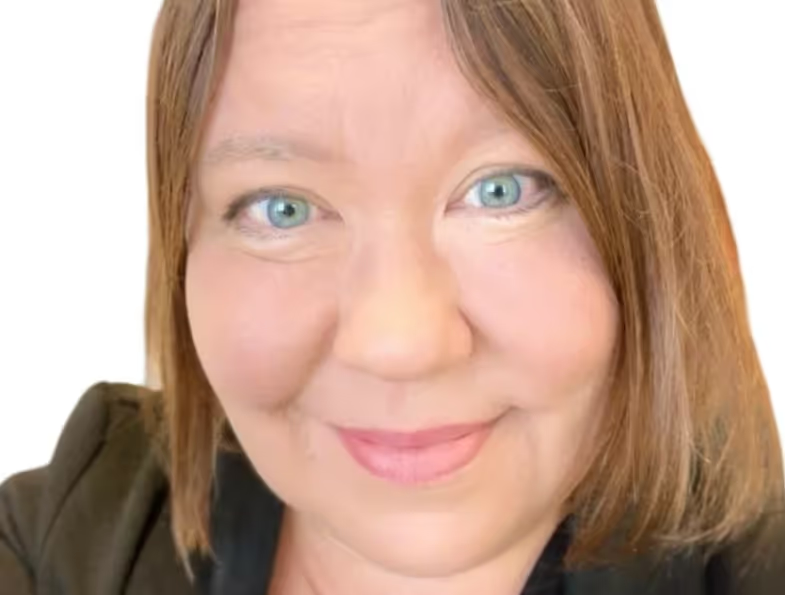
Arto Palmu, M.D., Ph.D., University Lecturer in Clinical Epidemiology and Chief Scientific Officer at FVR – Finnish Vaccine Research, has extensive experience in designing and conducting large pragmatic vaccine trials. He currently leads FinDementia, a randomised pragmatic trial aiming to recruit more than 33,000 participants. We asked him where pragmatic trials add most value, when planning should begin and which design choices matter in practice.
Pre-licensure trials are designed to answer specific regulatory questions. Their endpoints are often deliberately narrow and highly specific, for example efficacy against etiologically confirmed disease. “Once the vaccine moves towards routine use, the question changes to, for example, How much can vaccination actually reduce the disease burden in the population?” Arto says.
That may mean looking at effectiveness in routine use, longer-term outcomes, effects in risk groups, alternative dosing schedules or broader clinical outcomes than those used in the clinical development programme.
The evidence gap can be particularly important when marketing authorisation is based on safety and immunogenicity data - a randomised pragmatic trial can provide direct high-quality evidence of the vaccine’s effect on clinical disease.
If additional effectiveness evidence will clearly be needed after approval, Arto sees little reason to postpone the planning. “The optimal situation is to think about this early. It may even influence the scope of the trials leading to marketing authorisation.”
This matters especially when the planned pragmatic trial requires very large participant numbers or several years of follow-up. Starting earlier can bring the evidence forward substantially – and in some cases, the trial itself can begin before marketing authorisation.
A large pragmatic effectiveness trial can be started once there is strong enough evidence of safety and a credible indication of efficacy, even if the final marketing authorisation is still pending. This has already been done in Finland.
“You accept some development risk by starting before the final marketing authorisation. But these are long trials. The earlier you start, the earlier the evidence becomes available.”
Once the evidence need is clear, one of the most important practical questions is what can be measured reliably without active follow-up. In Finland, up-to-date and comprehensive national health registers can provide data on hospitalisations and diagnoses, outpatient healthcare contacts, medication use and microbiologically confirmed infections, among other outcomes. Relevant outcomes can then be identified from register data without repeated study visits simply to establish whether an endpoint has occurred.
For trials involving tens of thousands of participants and long follow-up, the effect on cost and feasibility is substantial. “The cost of long-term register follow-up is only a fraction of active follow-up of the type used in a Phase III trial,” Arto says.
Arto sees particular value in hybrid designs that combine randomisation and register follow-up with selected active assessments. The currently ongoing FinDementia trial, which investigates whether there is a causal link between shingles vaccination and a reduced risk of dementia, is one example.
The FinDementia trial uses long-term register follow-up based on Finland's national health registers, but also includes blood sampling, participant questionnaires and a brief cognitive screening test at baseline. Participants are randomised 3:1, meaning that 75% receive the active shingles vaccine and 25% placebo. The design remains controlled and blinded, but is more attractive to potential participants than a 1:1 allocation.
“First establish what can be obtained reliably from routine data. Then collect actively only what is needed to answer the remaining questions,” says Arto.
Pre-licensure trials commonly use very strict eligibility criteria to demonstrate a vaccine’s specific effect under ideal conditions. But that same approach can weaken a pragmatic trial if the aim is to estimate effectiveness in routine use.
“The result should be directly generalisable to the population in which the vaccine will actually be used,” Arto says. “If the vaccine is intended also for risk groups, immunocompromised people or very old adults, these populations should not be excluded without a clear rationale.”
Large randomised pragmatic trials are especially suitable for answering a broader question: does vaccination reduce total clinical disease burden, not only disease caused by the target pathogen? Arto refers to this as a vaccine probe approach to study less specific outcomes.
A pneumococcal vaccine trial, for example, may demonstrate efficacy against pneumococcal pneumonia. But for population-level decision-making, another question matters: how much does vaccination reduce pneumonia overall?
“The purpose of vaccination is not simply to change which pathogen is causing the disease. The important question is whether the total disease burden in the population is reduced.”
Arto sees no reason to limit pragmatic randomised designs to vaccines. Similar questions arise with medicines, particularly where several established treatment options exist but strong randomised evidence on long-term comparative outcomes is limited.
He mentions hypertension, lipid disorders and diabetes as examples where pragmatic trials combined with register follow-up could be valuable.
“In many common diseases we have several different medicines and treatment classes, but much less strong randomised evidence on which option gives the best long-term outcome for the patient and for public health.”
Arto’s advice is not to start by asking whether a programme needs a pragmatic trial. Start with the evidence that will still be missing when the conventional development programme is complete.
“If answering that question requires a broad target population, large numbers of participants or long-term follow-up, a pragmatic randomised trial may be the right tool to provide high-quality evidence. If the evidence will clearly be needed after launch, consider whether the planning – or even the trial itself – should begin before marketing authorisation.”



FVR - Finnish Vaccine Research Ltd.
Peltokatu 26, 33100 Tampere
Business ID 3256659-4
info@fvr.fi
Invoicing instructions
Data protection I About cookies I Self-monitoring plan
Osana-tuki: help@fvr.fi

Copyright 2026 FVR - Finnish Vaccine Research


